
How fast can emergency sanitation get set up in Lakewood?
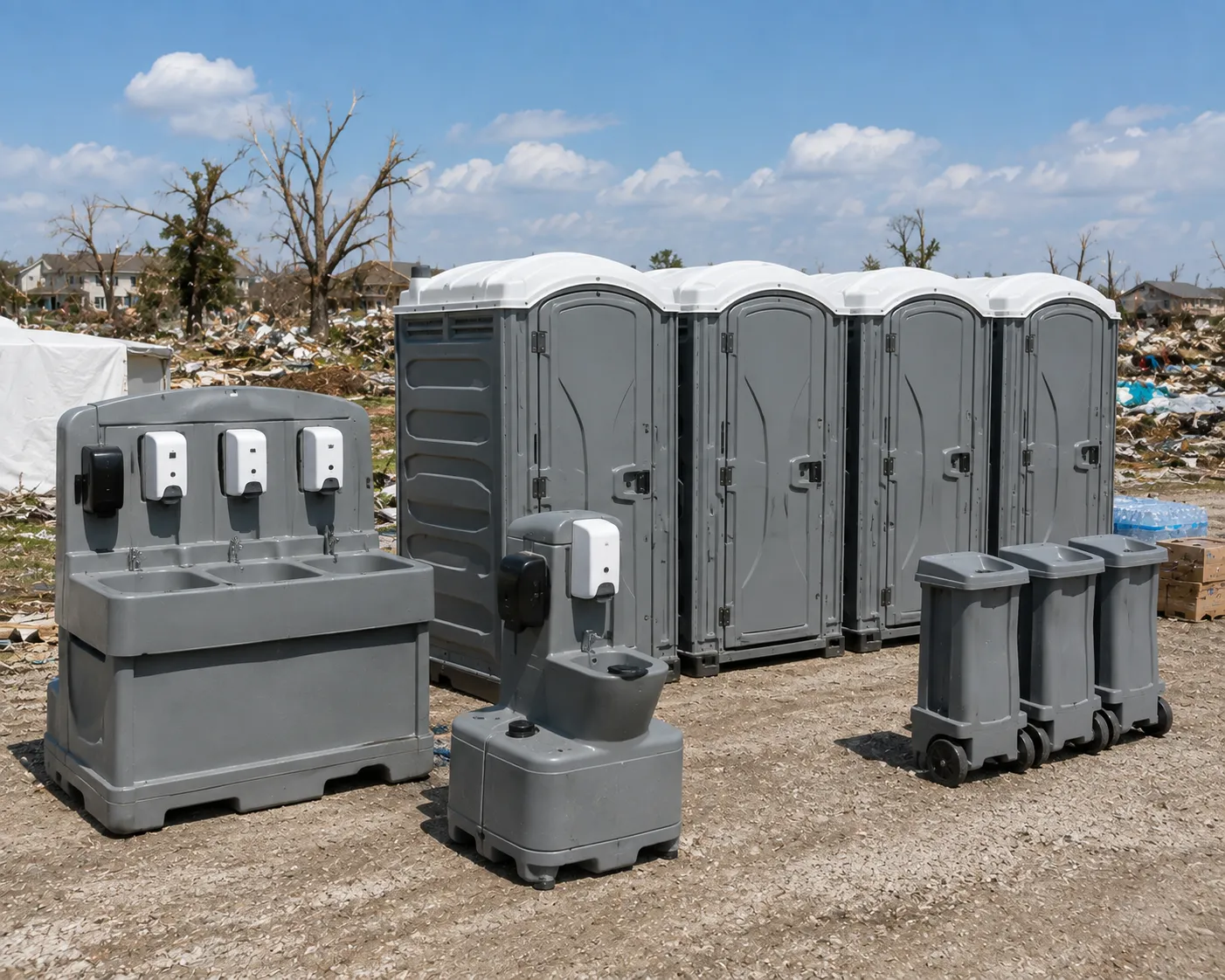
Most disaster deployments move on a same-day or next-day basis, depending on how many units the situation calls for and how the site can be accessed. A single emergency porta potty rental for a household without water service is a quick drop. A multi-block response with shelters, staging areas and volunteer crews takes more coordination, more units and more service visits per week. For anything involving a restroom trailer rental, we need clear ground and a level pad, and delivery crews want roughly 60 feet of straight clearance behind the truck to back in and set the unit down safely.
We size the response the same way we size any large job: count the people, not just the address count. If responders or displaced residents are working a hand-labor recovery effort like debris clearing, OSHA 1926.51(c) sets the baseline most disaster planners lean on, which calls for 1 toilet facility per 20 workers on a crew, moving to 1 toilet and 1 urinal per 40 workers as the crew grows past 20. That ratio is a solid starting point even when the "workers" are volunteers filling sandbags rather than a construction crew. Our how many porta potties do i need guide walks through the math for shelters, staging lots and residential clusters if you want to run your own numbers before calling.
What sanitation equipment works best for a disaster response?
Standard units cover the largest share of a disaster deployment because they are fast to place and easy to multiply. A standard unit runs about 44 by 48 inches on the ground and stands roughly 92 inches tall, with a 60 to 70 gallon holding tank, so a cluster of them fits into a parking lot or church lawn without much site work. For a shelter running for a week or more, a portable restroom rental cluster paired with a handwashing station rental covers basic sanitation needs, and under 29 CFR 1910.141(d)(2) those stations need actual soap and towels or a hand-drying device, not just sanitizer.
Where the response includes anyone with a mobility limitation, ADA Standards section 213.2 requires at least 5 percent of a clustered bank of units to be accessible, and never fewer than one. If the disaster has damaged municipal water or sewer lines and a household needs a temporary holding solution instead of a toilet swap, a holding tank rental can bridge the gap until the septic system is back online. Lakewood sits close enough to several response corridors that staging from a base near Wheat Ridge, 5.8 miles north, or Golden, 9.2 miles northwest, is often faster than routing everything through one central yard. For septic systems damaged by flooding, our emergency septic service crews can pump and assess a tank the same day, since a typical residential tank that would normally go 3 to 5 years between services may need an out-of-cycle pump after significant water intrusion.
| unit | duration | typical price |
|---|---|---|
| standard | day | $150 |
| standard | week | $200 |
| ada | day | $230 |
| trailer | day | $800 |
| delivery_fee | day | $150 |
Do you provide equipment for shelters and staging areas, not just individual homes?
Yes. We supply shelters, church staging sites and volunteer command posts across Lakewood with the same equipment we deploy on large construction jobs, just compressed into a faster timeline. A shelter housing dozens of displaced residents needs the same toilet-to-person ratios that OSHA 1926.51(c) lays out for a jobsite, plus a reliable water supply, since OSHA 1926.51(a)(1) calls for an adequate supply of potable water at any place people are working or sheltering. We also bring temporary fence rental for staging areas that need to keep vehicles and equipment separated from foot traffic, and light tower rental units for overnight operations when power is still out. If debris removal is part of the response, a roll-off dumpster rental or two keeps a staging lot from turning into its own hazard, and OSHA 1926.25 housekeeping rules on clearing debris from work areas apply just as much to a disaster site as a construction site. For crews handling contaminated debris or working with cleanup chemicals, OSHA 1926.51(f)(1) requires washing facilities wherever paints, coatings, herbicides or insecticides are in use.
Pricing during a disaster response tracks close to our standard porta potty rental cost numbers, though a compressed timeline sometimes carries a higher delivery fee. See our full porta potty rental per day breakdown for day-rate specifics, or check monthly porta potty rental pricing if the recovery is expected to run for weeks. For the broader picture of what we bring to a jobsite or emergency site, our construction site services page covers fencing, power and storage together.
How many toilets does a shelter need?
It depends on headcount, not square footage. Using the OSHA 1926.51(c) ratio as a guide, a shelter housing 20 people or fewer needs at least one toilet facility, and that scales up from there. Our how many porta potties do i need guide has the full breakdown by group size.
Can you deliver on short notice during an active disaster response?
Usually, yes. We prioritize disaster deployments and can often move a standard porta potty rental same day if the site is accessible. Availability during a widespread regional event can tighten fast, so call as soon as the need is confirmed.
Do you provide ADA accessible units for shelters?
Yes. An ADA accessible porta potty unit is available for shelter deployments, and clustered banks need at least 5 percent accessible under ADA Standards section 213.2, never fewer than one unit.
What if our septic system flooded during the disaster?
Call our emergency septic service line. Flooded tanks often need an out-of-cycle pump well before the normal 3 to 5 year interval, and a fast pump-out limits backup risk into the home.
Do you serve areas near Lakewood during regional disasters?
Yes. We stage and deliver across Lakewood and can reach nearby response points including Wheat Ridge and Golden. Check service areas for the full coverage list during a regional event.
Next step
Get a delivery date
Tell us the address, the dates and the headcount. We size the order and confirm the route.