
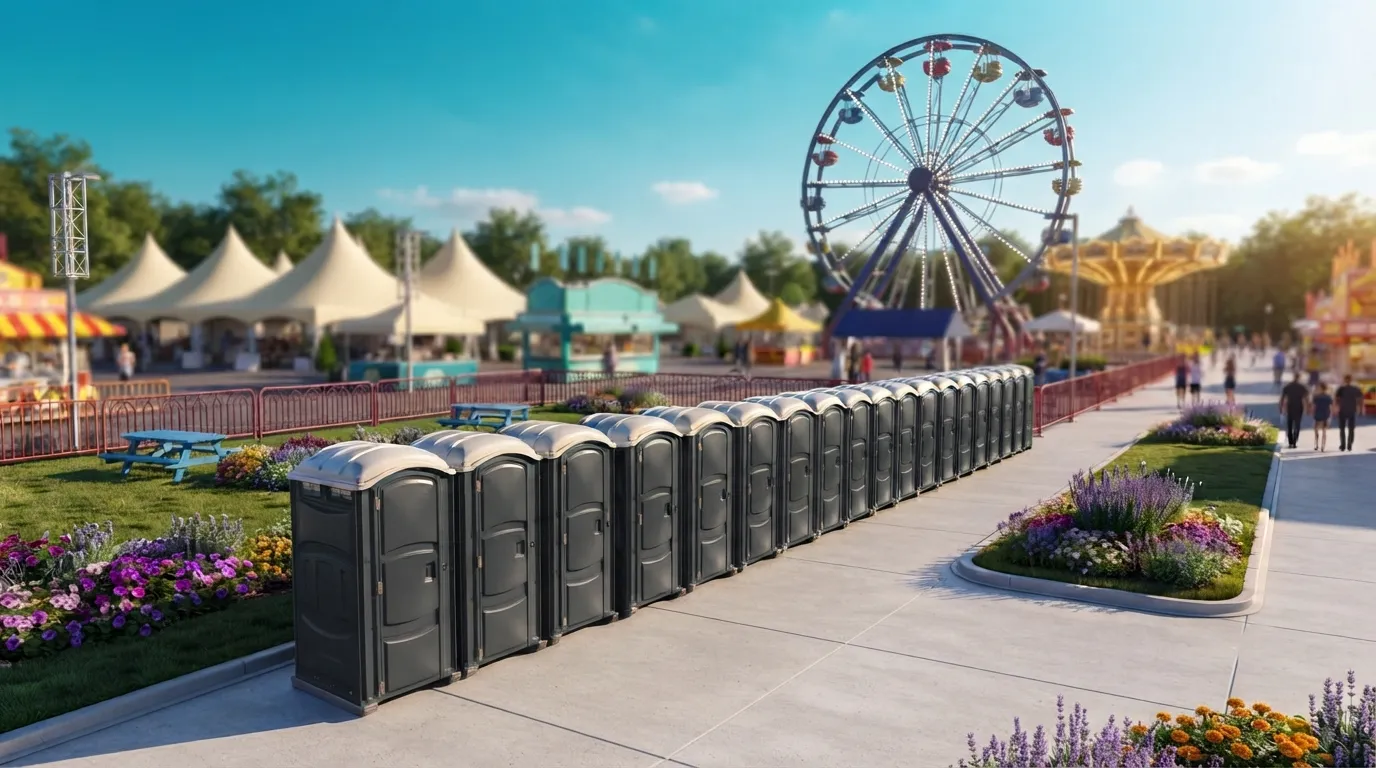
How many restrooms does a county fair need?
Start with attendance, then work backward. OSHA 1926.51(c) sets construction-site ratios, but fairgrounds aren't a construction site, so the useful benchmark is ANSI/PSAI Z4.3, which treats one service visit per week as the baseline for up to 10 steady users over a 40 hour week. A fair isn't steady traffic either. It's a surge. Plan for peak-hour crowding, not the daily average, or you'll have lines by noon.
For a two-day fair in Lakewood pulling a few thousand people, most organizers land on a mix of standard porta potty rental units and a couple of ADA accessible porta potty placements. ADA Standards section 213.2 requires that where single-user units are clustered, at least 5 percent be accessible, and never fewer than one. That's not optional at a public event with a paid gate. If your fair draws families with strollers and older visitors, add width: ADA Standards section 403.5.1 calls for a 36 inch clear route to each accessible unit, and 404.2.3 sets the door opening at 32 inches minimum.
Not sure where to start with the math? The how many porta potties do I need guide walks through headcount ratios in more detail, and our porta potty rental checklist covers what to confirm before the gates open.
What does county fair restroom rental cost in Lakewood?
Pricing depends on unit mix, rental length and whether you need delivery on setup day and pickup the day after teardown. A standard unit rented for a multi-day event typically runs in the event-rate band shown below, and ADA units carry a premium for the added footprint and service.
| Unit | Day | Week | Event Rate |
|---|---|---|---|
| Standard | $100 - $350 | $130 - $500 | $200 - $800 |
| ADA accessible | $200 - $400 | -- | -- |
| Deluxe flushable | $85 - $1,200 | $150 - $290 | -- |
Delivery fees run separately, typically $100 to $500 for a single drop depending on distance and access. A fair with a beer garden or food court usually adds a deluxe flushable porta potty or two near the VIP or vendor area, since flush units handle higher-traffic zones better than standard ones. For a full breakdown by duration, see porta potty rental cost or the porta potty rental per day page. If your fair runs into a fourth week of setup and teardown, monthly porta potty rental pricing may actually beat renting by the day.
Vendors need water, too. OSHA 1926.51(a)(1) requires an adequate supply of potable water at any place of employment, which applies to fair staff and concession crews working the grounds. A handwashing station rental or two near the food court covers that, and food vendors handling raw ingredients should also have a portable sink rental close by, since 29 CFR 1910.141(d)(2) requires soap and towels or a hand-drying device at washing facilities, not just sanitizer.
Where should restrooms go on the fairgrounds?
Placement decides whether restrooms actually get used or just get complained about. Cluster units near high-traffic anchors: the main gate, the grandstand, the food court, and any livestock or exhibit barn where hands need washing after animal contact. ADA Standards section 302.1 requires the ground under and around each unit to be stable, firm and slip resistant, which matters on grass fairgrounds after a Lakewood rain. A gravel or plywood pad under ADA units also helps meet the 60 inch turning circle required by section 304.3.1.
Keep at least one cluster within a short walk of parking, since fairgoers won't cross the whole grounds to find a restroom. If your fair spans multiple lots or a livestock area separated from the midway, treat it like two events and duplicate your restroom cluster rather than making people walk. Our porta potty placement guide covers ground surface, service truck access and sightline considerations in more depth.
Service access matters as much as placement. Pump trucks need a real path to each cluster, and a roll-off dumpster rental near the food court needs about 60 feet of straight clearance behind the truck for delivery. Fairs in Lakewood sometimes route service vehicles through the same gate as vendor deliveries; confirm that with fairgrounds staff before your event, since routes can conflict with crowd flow during open hours. If your fair includes camping for exhibitors or vendors overnight, look at camping porta potty options too, since those units see different traffic patterns than day-use restrooms.
Fairs 8 to 10 miles from Lakewood, in towns like Golden or Wheat Ridge, use the same placement logic, just scaled to their own grounds. If you're planning grounds outside Lakewood proper, check service areas for coverage, or browse nearby listings like porta potty rental in Golden, CO and porta potty rental in Wheat Ridge, CO.
How far in advance should I book fair restrooms?
Book as soon as your date and headcount are set, ideally 4 to 6 weeks out for a multi-day fair. Fairgrounds with limited access roads or tight vendor schedules need extra lead time for delivery trucks. Waiting until the week before limits unit availability and options for ADA placement.
Do county fairs need ADA accessible units?
Yes. ADA Standards section 213.2 requires at least 5 percent of clustered single-user units be accessible, with a minimum of one, at any public event. A county fair with paid admission and public access qualifies. Skipping this exposes organizers to complaints and compliance risk.
How often are units serviced during a multi-day fair?
Multi-day fairs usually get at least one service visit daily, sometimes twice for high-traffic clusters near food courts. ANSI/PSAI Z4.3 treats weekly service as baseline for steady low-traffic use, but fair crowds need far more frequent pumping and restocking to avoid backups.
Can we add handwashing stations near the livestock barns?
Yes, and it's worth doing. Livestock areas need water access for both exhibitors and visitors touching animals. A hand sanitizer station rental supplements but doesn't replace real handwashing per 29 CFR 1910.141(d)(2), which requires soap and towels.
What happens if we underestimate attendance?
Lines back up fast, usually within the first few hours of peak traffic. Cornerstone Porta Potty can often add units mid-event if access allows, but it's better to overestimate slightly during planning than to scramble on fair day with trucks competing for gate access.
Next step
Get a delivery date
Tell us the address, the dates and the headcount. We size the order and confirm the route.